Jekyll2026-10-13T07:28:35+00:00https://vneyt.github.io/stephenkingatwork/feed.xmlStephen King At WorkVincent Neyt, University of AntwerpPre-IT References to Derry in King Stories2025-06-24T00:00:00+00:002025-06-24T00:00:00+00:00https://vneyt.github.io/stephenkingatwork/2025/06/24/pre-it-references-to-derry-in-king-storiesStephen King’s novel IT, published in 1986, is set in the fictional town of Derry. Although no other work published before IT is set in Derry, the town is mentioned in no less than five stories that appeared prior to 1986. So did King create Derry for IT, or was it already part of his fictional universe before he began that book?
I believe Derry was first conceived as the setting of IT and that it premiered in King’s work in the first draft of IT, which he began in August 1980. Once the draft was finished, in June 1981, the novel became part of King’s oeuvre, you could say, and the fictional town of Derry “appeared” on his map of Maine. He knew IT would be published at some point down the line, but that it would be a while. During that five-year wait, King amused himself by putting references to Derry in several stories that were published between 1981 and 1986: The Running Man (May 1982), The Body (August 1982), “Uncle Otto’s Truck” (October 1983), Pet Semetary (November 1983), and “Mrs. Todd’s Shortcut” (May 1984) and “The Revelations of ‘Becka Paulson” (July/August 1984).
In May 1982 The Running Man by “Richard Bachman” hit bookstores in the US and in Canada. The novel’s thrilling finale takes place largely in “Voight Airfield” in Derry, Maine. At this point very few people knew or suspected that King was Bachman. What a jedi-mind-trick to “premiere” your newest fictional town in another author’s work.
Three months after Bachman published The Running Man, Different Seasons came out in August 1982. With this book King pulled off the almost un-pull-offable: a successful collection of novellas. One of those novellas is the fantastic The Body. The story itself was written around May/June of 1973, after King finished a draft of ‘Salem’s Lot. But when he prepared it for submission to Viking in the second half of 1981, he put in a reference to Derry. I’d bet my left pinky toe “Derry” wasn’t in the first draft of the story.
The town of Derry next appeared in print in the October 1983 issue of Yankee magazine, containing King’s short story “Uncle Otto’s Truck”. It was written after he had completed IT. One month later, another novel hit the shelves with a quick reference to Derry: Pet Sematary. The book was in stores in November 1983. The first draft, written in 1979, did not contain the reference; Derry was a second-draft addition.
“Mrs. Todd’s Shortcut” first appeared in Redbook magazine, in May 1984. In the afterword to Skeleton Crew King said Mrs. Todd is actually his wife, who always seemed to be on the lookout for shortcuts. When King wrote the short story he had finished IT and already done a lot of work on The Tommyknockers, so, like Derry, the town of Haven was now a part of his fictional universe. Haven is mentioned along with Derry and Bangor.
The final pre-IT occurrence of the fictional town of Derry was in the story “The Revelations of ‘Becka Paulson”, which appeared in the July/August 1984 issue of Rolling Stone magazine. There’s just a very cursory mention of Derry in this one. King later incorporated the story into The Tommyknockers, changing a few things to make it fit.
Most SK fans would not have gotten to read The Running Man, “Uncle Otto’s Truck” and “Mrs. Todd’s Shortcut” until 1985, when these two books came out: The Bachman Books and Skeleton Crew. For ‘Becka Paulson’s conversation with Jezus they needed to wait even longer, until 1987, when The Tommyknockers came out. This somewhat odd situation sometimes creates some confusion among King readers, but a look behind the scenes at the order these stories were originally written in, and when they were rewritten, can conform that King created Derry for IT in 1980-81, and then retro-fitted Derry into new drafts of earlier stories (The Running Man, The Body and Pet Sematary) and dropped casual references in short stories he wrote between 1981 and 1985 (“Uncle Otto’s Truck”, “Mrs. Todd’s Shortcut” and “The Revelations of ‘Becka Paulson”).
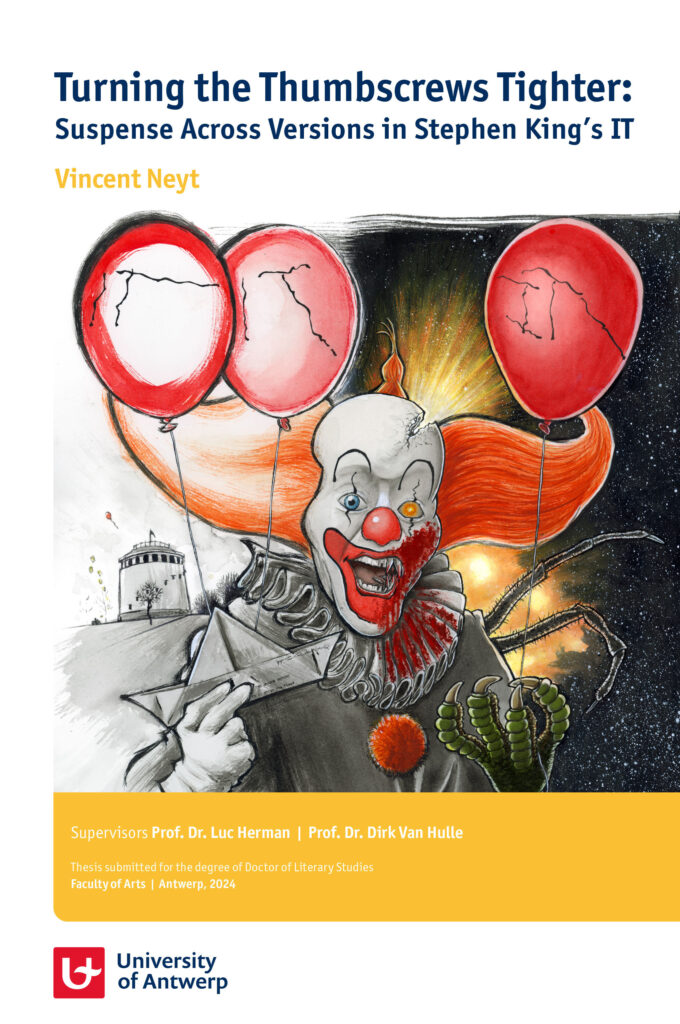
]]>PhD: Turning the Thumbscrews Tighter2024-10-12T00:00:00+00:002024-10-12T00:00:00+00:00https://vneyt.github.io/stephenkingatwork/2024/10/12/phd-turning-the-thumbscrews-tighterMy dissertation, “Turning the Thumbscrews Tighter: Suspense Across Versions in Stephen King’s IT” is now available in open access for all to read! I wish to thank Stephen King for giving his kind permission to reprint the quotes from his drafts and letters that are included in the dissertation.
A pdf of the full text can be downloaded via this link:
After the dissertation was completed, a source became available that sheds new light on the dating of King’s work on the second and third drafts of IT. In subchapter 2.3 of my text, I situate King’s writing of the second draft somewhere between March 1983 and March 1984, based on King’s statements in several interviews in March 1984 that IT was ready and would come out within a year. From this I inferred that a second draft must have been completed.
In July of this year, the “I couldn’t throw it out” podcast released an audio recording of an interview with Stephen King and Peter Straub, recorded in October, November or December of 1984. The authors talked mainly about the recent publication of The Talisman, but at the end King clearly stated that a new novel IT is “now about one eighth done in second draft”. He also mentioned having recently completed the first draft of Misery, which he called “The unwanted pregnancy that I had this summer”.
Based on these two new elements, I think that King told interviewers in March 1984 that IT would come out within a year because he had scheduled to devote the summer of 1984 to his second draft, and intended to do his third draft “polish” immediately after. By that timing he could have been ready to submit his novel in late 1984 or early 1985. But inspiration struck, and he ended up spending the summer on the first draft of Misery. The final page of that draft lists the date September 23rd, 1984, the date of completion. Work on the second draft of IT was then pushed back to the fall of 1984, and because of King making a commitment to direct Maximum Overdrive in 1985, writing the second and third drafts of IT ended up taking from October or November 1984 until the end of December, 1985.
]]>PhD Defense2024-09-04T00:00:00+00:002024-09-04T00:00:00+00:00https://vneyt.github.io/stephenkingatwork/2024/09/04/phd-defenseVincent’s PhD is ready; he will defend it on 4 October.
]]>Video: Stephen King and his Proofreaders2024-09-04T00:00:00+00:002024-09-04T00:00:00+00:00https://vneyt.github.io/stephenkingatwork/2024/09/04/video-stephen-king-and-his-proofreaders
Who are the lucky people that get to read Stephen King’s first drafts of his novels? Here’s a look at some of the main people that King has relied on throughout his long career to proofread his manuscripts, going all the way back to his student days: Burt Hatlen, Susan Artz, Tabitha Spruce King, George Everett McCutcheon, Russ Dorr, Owen King and Joe Hill.
When we started work on this over a year ago, our research question was simply: would current methods in computer stylometry be able to identify King’s style in his novels published as Bachman? This proved to be the case. Additionally, we asked ourselves which aspects of King’s style were so present in the early Bachman books that may have caused many readers at the time to have strong suspicions that Bachman was King. We arrived at his use of brand names and references to popular culture as a clearly identifiable characteristic of his texts.
Here is the abstract of our article:
Between 1977 and 1984, Stephen King published five novels under the pseudonym “Richard Bachman”. Reviewers noted similarities between King’s and Bachman’s writing styles when Thinner (1984) was published, ultimately leading to King’s unmasking. We investigate whether computational authorship analysis techniques can correctly identify King as the author of the Bachman books out of a selection of contemporary candidate authors – Dean Koontz, Peter Straub, and Thomas Harris. We also perform a post-hoc analysis of the use of pop-culture references and brand names in Bachman, King, Koontz, Straub, and Harris novels, based on comments in reviews of Bachman and King novels. The references extracted from the Bachman books occurred significantly more often in King’s texts than in the others’, showing that attentive readers could have “heard King’s voice” in the Bachman books through what a reviewer denigratingly called King’s “compulsion to list brand-name products and his affinity for pop-cult teenage junk”.
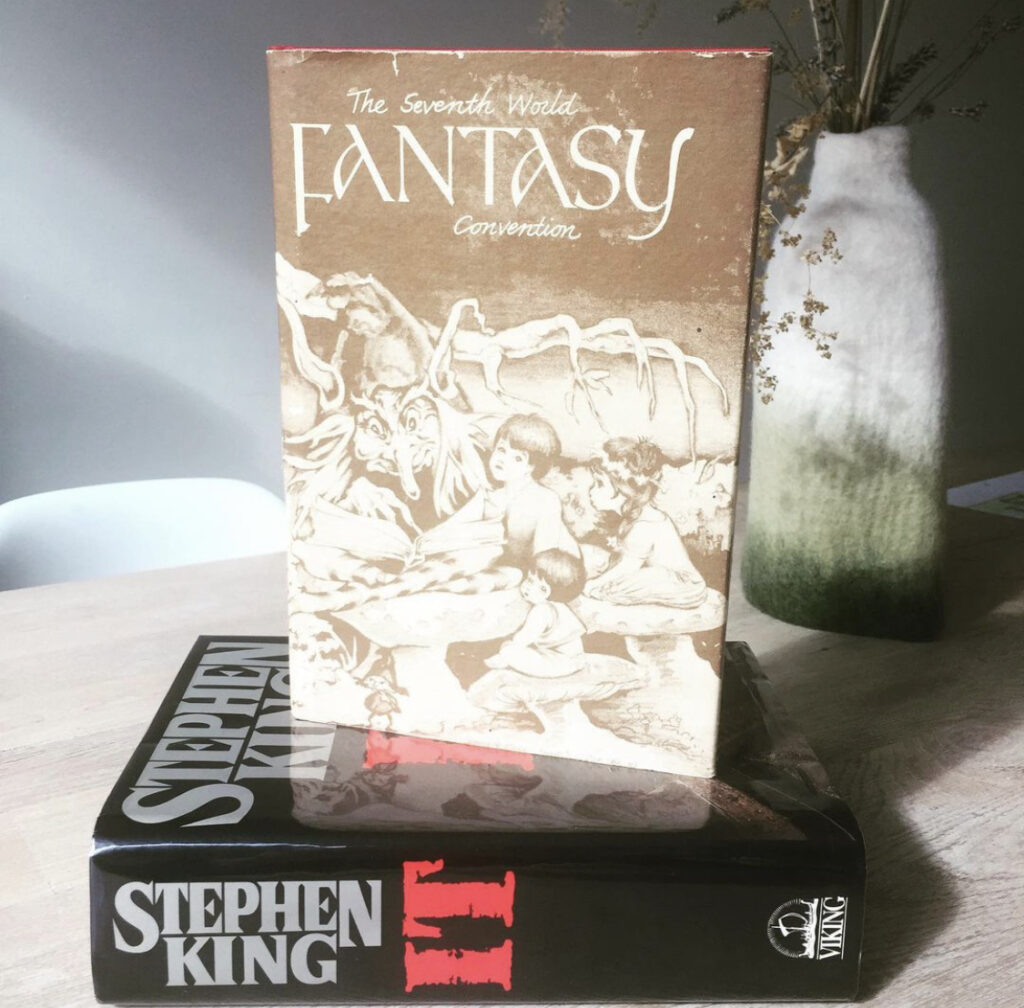
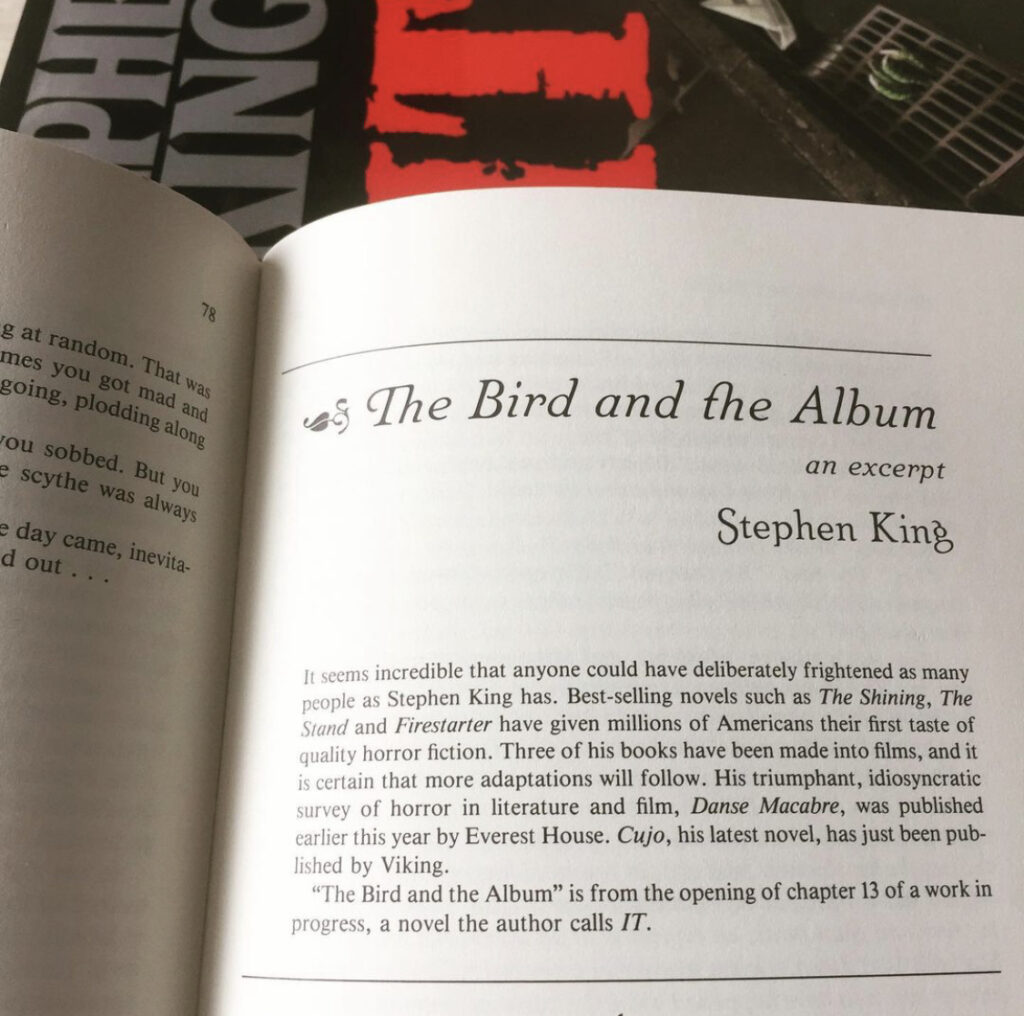
]]>The Bird and the Album2024-03-04T00:00:00+00:002024-03-04T00:00:00+00:00https://vneyt.github.io/stephenkingatwork/2024/03/04/the-bird-and-the-albumKing finished the first draft of IT in the late spring of 1981. During the summer of that year, Jack Rems and Jeff Frane were soliciting contributions for a book that was going to be presented as a gift to the visitors of the seventh edition of the World Fantasy Convention. This three-day convention was held each year around the time of Halloween. In 1981, it took place in Berkeley, California, from October 30th to November 1st. A thousand copies of the anthology were printed and the book was titled A Fantasy Reader: The Seventh World Fantasy Convention Book.
As Jack Rems remembers it, he asked King for “the last dozen or so pages out of his typewriter”. What King sent could not have been the last pages out of his typewriter, however, as the draft was finished by this point. King’s contribution to the Fantasy Reader consisted of pages 632 to 639 of the first draft: the complete first subchapter and 26 lines of subchapter 2 from chapter 13: “The Bird and the Album” (retitled to “The Album” in the third draft). It’s the scene with the adults in the library where Mike opens his refrigerator to see the talking severed head of young Stan. Why King chose to submit these eight pages is unknown. They were reproduced verbatim in the Reader under the title “The Bird and the Album: an excerpt”, preceded by a short bio and a description of the text.
In the published novel (that came out five years after this prepublication), this became chapter 14, and the title was changed to simply “The Album”. The reason for this is that in the first draft Mike’s encounter with the bird Rodan was written out in chapter 13, and during the editorial process King moved that story to chapter 6, “One of the Missing”.
There are a few differences between this version and the published text. King’s most notable revision is to one of the derogatory things the severed head of Stan says to Mike. He tells him to get out of Derry if he knows how to use his head. In the prepublication text, Stan adds: “We don’t need people like you in Derry. No jigs, no coons, no midnight bombers. Your lips is too thick and you smell like polecat oil even if you shower four times a day. Your cock’s too long and you’re rhythm’s too natural. So use your head, Mikey” (A Fantasy Reader, page 83). King removed the racial slurs in his subsequent draft. There are other, similar revisions throughout the writing process where racist remarks made to Mike Hanlon or to his father were cut. Racism in Derry is still a theme of the published novel, but it was even more explicit in the first draft, as this published fragment shows.
The book for the WFC 7 turned out beautifully, with contributions by Robert Bloch, Peter Straub, T.E.D. Klein, Fritz Leiber, Ramsey Cambell, and many others. King attended the conference and signed quite a few of these books.
]]>BANGOR BEWARE! How King Moved to Bangor in 1980 to Write IT2023-10-26T00:00:00+00:002023-10-26T00:00:00+00:00https://vneyt.github.io/stephenkingatwork/2023/10/26/bangor-beware-how-king-moved-to-bangor-in-1980-to-write-itThe King family moved house several times between 1975 and 1980. In July 1975 they went from Boulder, Colorado to Bridgton, Maine, after having only lived in Boulder for a year. In the summer of 1977 the family traveled to England. They were supposed to stay for a year, as King wanted to write a novel about a ghost in a castle, but the novel never got going and after just three months they returned to the US in December. The Kings bought a property in Center Lovell, Maine. Half a year later (fall 1978), they moved north to a rented house in Orrington, near Bangor, when King was invited to teach at the University of Maine at Orono. In the spring of 1979 they returned to Center Lovell.
At this point, both King and his wife Tabitha were tired of all the moving around. They wanted to settle down permanently, and the rural house in Center Lovell was not the right place for that, for a number of reasons. Tabitha wanted their children to live near other kids. The Center Lovell house, with its picturesque setting beside Kezar Lake, was surrounded by summer homes, and the area was deserted for nine months of the year. The family also wanted the amenities and sense of community offered by a city. Tabitha suggested Portland, Maine, and King suggested Bangor.
In 1979 […] we looked in two places, we looked in the Bramhall district in Portland, and we looked on West Broadway in Bangor, which was the street that we both knew. Tabby from when she grew up in Old Town and would come in to use the library, and me from when I went to the university of Maine and used to come into Bangor to use the library. And we talked about it, and there were things about Portland that we liked very much, but what we liked about Bangor was a sense of community with no frills, a community where people really did seem to care about each other, where we had ties from our university years, where people had learned to get along with us, and to be friends with us in spite of the shrill politics of the late Sixties. (Source: YouTube)
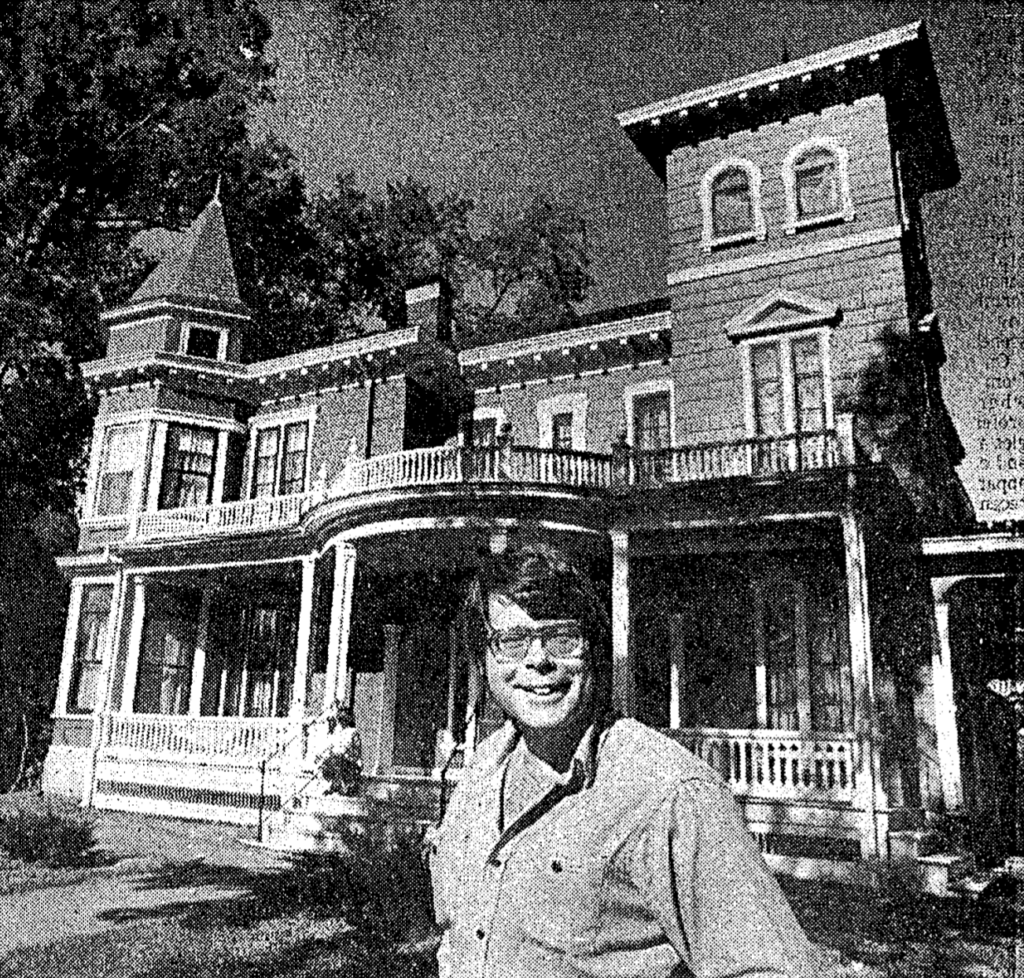
The now-iconic house they bought was known locally then as the “William Arnold House”. It was the first house to be built on West Broadway Street, completed by William Arnold around the middle of the nineteenth century. “As a girl [Tabitha King] strolled down West Broadway with a friend and dreamed of living in one of the mansions. She leaned towards the red one with the towers [ie. the William Arnold House].”1 When the house came up for sale in 1980, the Kings did not hesitate. “I thought it was destiny,” Tabitha later remarked.1
At the beginning of July 1980, King spoke to a reporter of The Bangor Daily News and announced that the family would be moving there, and that Bangor would be the setting of a new novel he planned to write: “For five years I’ve wanted to write a book set in a fictional Maine city”. Of course he would change its name, adding menacingly: “For the purposes of my fiction, I would have to do whatever I have to do to Bangor”. King also mentioned the importance of the Bangor Public Library for his writing of the book: “Aside from the standard haunted house setting favored by horror writers, Bangor will provide the considerable resources of its public library, which King said contains one of the country’s best fiction collections and a lot of material about Bangor itself.” He intended to spend most of the winter of 1980-81 working on the first draft.2
United Press International noticed King’s announcement and sent out the following short item that was printed in the faits divers section of several newspapers under the heading “BANGOR BEWARE!”:
What Stephen King — master of powers dark and fell — did to Las Vegas in “The Stand”, he’s about to do to Bangor, Maine, in a book as yet untitled. King says he’ll make Bangor his permanent winter home, just so he can write his next thriller — and he’s characteristically sinister about it. Says he, “for the purposes of my fiction, I would have to do whatever I have to do to Bangor.” He will show the chamber of commerce one point of mercy. He’ll change the name. (The San Francisco Examiner, 7 July 1980, A13)
On the 27th of March 1983, when the family had not yet lived there a full three years, King was asked to speak about why he chose to live in Bangor, “from a novelist’s perspective”. That evening, King said:
West Broadway attracted us, with its graceful Victorian homes, its lovely trees, and its feeling of being a peaceful sort of inlet very close to the bustle of downtown. Fairmount School, a neighborhood school, a school our children could walk to, attracted us […]. […] Nevertheless, it was as much the novelist as the man who wanted to come to Bangor. I had a very long book in mind, a book which I hoped would deal with the way myths and dreams and stories — stories, most of all — become a part of the everyday life of a small American city. […] The real answer is that no, not any small American city would have done. Portland certainly wouldn’t have done. And no, I don’t know why. Maybe the book itself will answer the question (but if it does, I suspect the answer will lie in the narrow white spaces between the lines).3
As he was addressing the members of his new community King seems to have been hesitant to name the reason for choosing Bangor, saying, “no, I don’t know why”. On other occasions however, he had no problem stating that it was the city’s roughness that attracted him. A month after having moved there, King described Bangor to a reporter as a “hard town”: “They busted a lot of people here during the Viet Nam war. They won’t stand for much. It’s a hard-drinking, working man’s town. They’re just as likely to set fire to your hair in a bar if they don’t like the way you’re talking” (The Toronto Star, 5 October 1980).
King begun his work on IT not long after moving into the new house in August 1980. He was a guest on David Letterman’s morning show on the 18th of August, the first day of a seven-day promotional tour for his newly published novel Firestarter. At the end of the interview, Letterman asked if he was working on a new book, and King said:
It is very likely that King is referring to IT here. In previous interviews between 1978 and 1980, King had said that he had been carrying around a scary idea for five years about a thing “in a kind of a subway system” that was to be set in Bangor and that he intended to write after moving there. It seems that by the 18th of August, he had begun the draft.
Every morning, he added six new pages to his first draft of the novel. At the same time, King read the local history books he borrowed from the Bangor Public Library. He was equally curious about the town’s folklore as told by its inhabitants. “So I went around town for one whole fall, and I asked people what they knew about various places that I wanted to incorporate into the book. And I would listen to the stories” (TIME.com). One Bangor myth about the sewer system fit the story perfectly:
The real deal-maker was when I found out that there was this entire network of sewers under my city. A lot of people didn’t know where they went anymore. The maps had been lost. They were built in the thirties, as part of the Elenor Roosevelt Work Programs, and they just built these sewers, and then they left them. Some guy said to me, “Well you know, in the spring, when the run off comes from the snow, you can put a canoe in over at Westgate Mall and it will come out at Mount Hope cemetery”, you know, five or six miles on the other side of town. And I thought to myself, “Man, that’s probably not true, but it ought to be. And I ought to put my monster’s lair in those sewers, and at some point, I’ll have the kids go down there. (Source: YouTube)
A journalist from The Toronto Star, who visited King on the 18th and 19th of September 1980 when he had only been working on IT for a few weeks, reported on such an inspirational early morning walk:
King sets out on his walk to sniff at the book. Tabby goes with him and they pass “The Bangor standpipe”–a hundred-year-old water tower that may one day appear in one of his stories. They explore an 1870 bird bath in the middle of a common, pass a variety store that’s the setting for one of his short stories. When he gets back to the house he checks test papers that son Joe has brought home from school. At almost 9:30 he picks up his iced water and his vitamin pills and goes into his office off the dining room. (The Toronto Star, 5 October 1980)
Both the Standpipe and the bird bath, of course, made their way into the novel, as did many other Bangor myths. King’s street, West Broadway, also makes occasional appearances throughout the novel. It’s described as “West Broadway, where the rich whites in Derry lived then and still live today”, and the kids at Derry Elementary who live on West Broadway are all snooty and rude to the members of the Losers’ Club.
In the end, King spent the fall, winter, and spring working on IT, completing his first draft in June 1981. When the book was about to be published in 1986, King was a bit worried how people in Bangor would react: “I would not be at all surprised to find that I had become persona non grata in my own town following the publication of this book”,4 but, on the contrary, over the years Bangor has embraced its link with Stephen King and Derry.
1.
Smith JH. A Girl’s Dream Comes True in Mansion Fit for Kings. Bangor Daily News. December 8, 1984:WM10-WM11.
2.
Platt D. Novelist Stephen King to live winters in Bangor. The Bangor Daily News. July 3, 1980:23.
3.
King S. A Novelist’s Perspective on Bangor. Black Magic & Music: A Benefit for the Bangor Historical Society. Published online March 1983:1-7.
4.
King S. Stephen King Comments on It. Castle Rock: The Stephen King Newsletter. July 1986:1,5.
]]>Danse Macabre and IT, Two Sides of the Same Coin2023-09-05T00:00:00+00:002023-09-05T00:00:00+00:00https://vneyt.github.io/stephenkingatwork/2023/09/05/danse-macabre-and-it-two-sides-of-the-same-coinKing wrote the first draft of IT between August 1980 and June 1981. Before putting the first sheet into his typewriter he had been developing his ideas for IT for about five years, as he told The Bangor Daily News in July 1980.1 King did not take notes or write outlines or character studies beforehand; all that work went on in his head.
Another project, begun in 1978, heavily stimulated his preparatory thinking about IT, so much so that the two texts can be seen as two sides of the same coin. The project became King’s first novel-length work of nonfiction, Danse Macabre, published in April 1981 by Everest House. He wrote the first draft in 1979, did an extensive rewrite of the text in the spring of 1980 in preparation of submission, and turned his attention to IT immediately afterwards.
The idea for Danse Macabre originated with King’s former editor, Bill Thompson. Thompson phoned King in November 1978 and asked, “Why don’t you do a book about the entire horror phenomenon as you see it? Books, movies, radio, TV, the whole thing”.2 The timing was fortuitous, because it overlapped with the work King was doing as a writer-in-residence at the University of Maine at Orono at the time, where he taught a course called “Themes in Supernatural Literature”. King liked the idea because it would allow him to formulate an answer to many of the questions he was so often asked: Why do you write horror? Why do people read horror? The book would be his “Final Statement on the clockwork of the horror tale”.2
The research and contemplation over the next year-and-a-half for his nonfictional Final Statement influenced and complimented his ideas for IT, which he envisaged during that gestation period as a long novel inspired by the folk tale “The Three Billy Goats Gruff”: the troll under the bridge would become a monster under a city; the goats crossing the bridge he saw as a metaphor for how every child needs to cross the bridge to adulthood and face the troll underneath.
I started thinking that I’d like to write a really long book, an out-and-out horror novel, with a guy something like me at the center of it. I thought of it as my final exam on all those questions I was being asked, a kind of SAT of grue, where — if I was good — I could answer all the questions, once and for all.3
Remarkably, King’s writing of a nonfictional Final Statement on the horror genre served as preparation (revision, one could say) for his fictional Final Exam as a horror writer, which he undertook directly after Danse Macabre was submitted. The two books approach the same subject from different directions — one is coming from the head, the other from the heart.
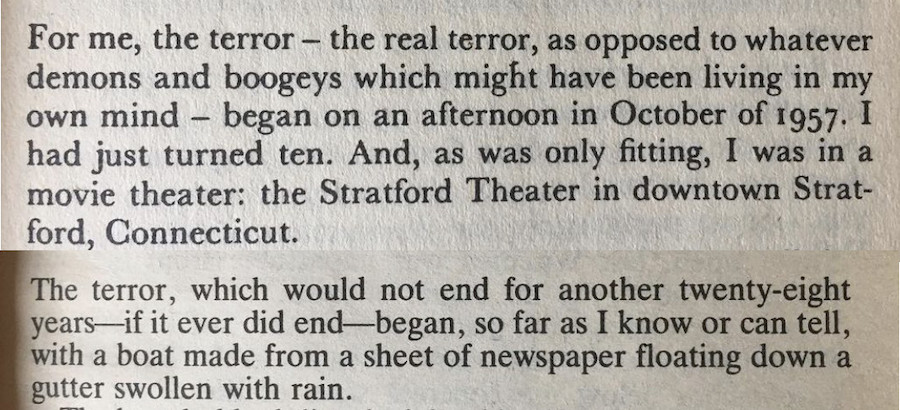
The connection is cemented from the start, as King mirrored the opening sentences. Danse Macabre starts: “For me, the terror — the real terror, as opposed to whatever demons and boogeys which might have been living in my own mind — began on an afternoon in October of 1957”. The then ten-year-old Stephen King was at a movie theatre for a matinee showing of Earth vs. the Flying Saucers. The manager interrupted the movie to break the news that Russia had successfully launched Sputnik 1. King remembered how it had terrified him that Russia had beaten the US into space: “For me, it was the end of the sweet dream…and the beginning of the nightmare”.2
The first sentence of IT is: “The terror, which would not end for another twenty-eight years — if it ever did end — began, so far as I know or can tell, with a boat made from a sheet of newspaper floating down a gutter swollen with rain”. For Bill Denbrough, the protagonist, the terror also began when he was ten, in October of 1957, when his younger brother was violently murdered.
This is the first of numerous striking similarities between the texts. King’s preparation in 1978 and ’79 can be said to have served for both books, and that the genesis of Danse Macabre overlaps with, interacts with, and can even be said to form a part of the genesis of IT.
In Danse Macabre King writes about growing up in nineteen-fifties America:
It was a decade when every parent trembled at the spectre of juvenile delinquency: the mythic teenaged hood leaning in the doorway of the candystore there in Our Town, his hair bejeweled with Vitalis or Brylcreem, a pack of Luckies tucked under the epaulet of his motorcycle jacket, a fresh zit at one corner of his mouth and a brand-new switchblade in his back pocket, waiting for a kid to beat up, a parent to harass and embarrass, a girl to assault, or possibly a dog to rape and then kill… or maybe vice-versa”.
King is describing a stereotype that has become a staple of popular culture, but he is undoubtedly also writing from personal experiences with such bullies in his own childhood. In IT, he subsequently created a fictional character, Henry Bowers, who is an embodiment of that exact stereotype. The straightforwardly descriptive portrait of the juvenile delinquent in Danse Macabre reads as a summary of the physical traits, habits, actions, thoughts, and motivations of the fictional Henry Bowers in IT. The parallels are striking: he has the jacket, the haircut and the switchblade; he waits for and ambushes Ben Hanscom and uses the pocket knife to carve an “H” into Ben’s belly; he poisons and kills Mike Hanlon’s dog; he assaults the adult shopkeeper of the Costello Avenue Market and breaks Eddie Kaspbrak’s arm; and in chapter 17 Beverly Marsh, although she doesn’t use the word, is justly afraid that Bowers will rape her if he catches her by herself in a secluded area.
Because of the five years between their publication dates, Danse Macabre and IT are never discussed in tandem in King criticism, but for King they were interconnected products of the same period of creative reflection on “the clockwork of the horror tale”, which he loved so much.
1.
Platt D. Novelist Stephen King to Live Winters in Bangor. The Bangor Daily News. July 3, 1980:23.
2.
King S. Danse Macabre. Futura; 1988.
3.
King S. IT. Cemetery Dance; 2011.
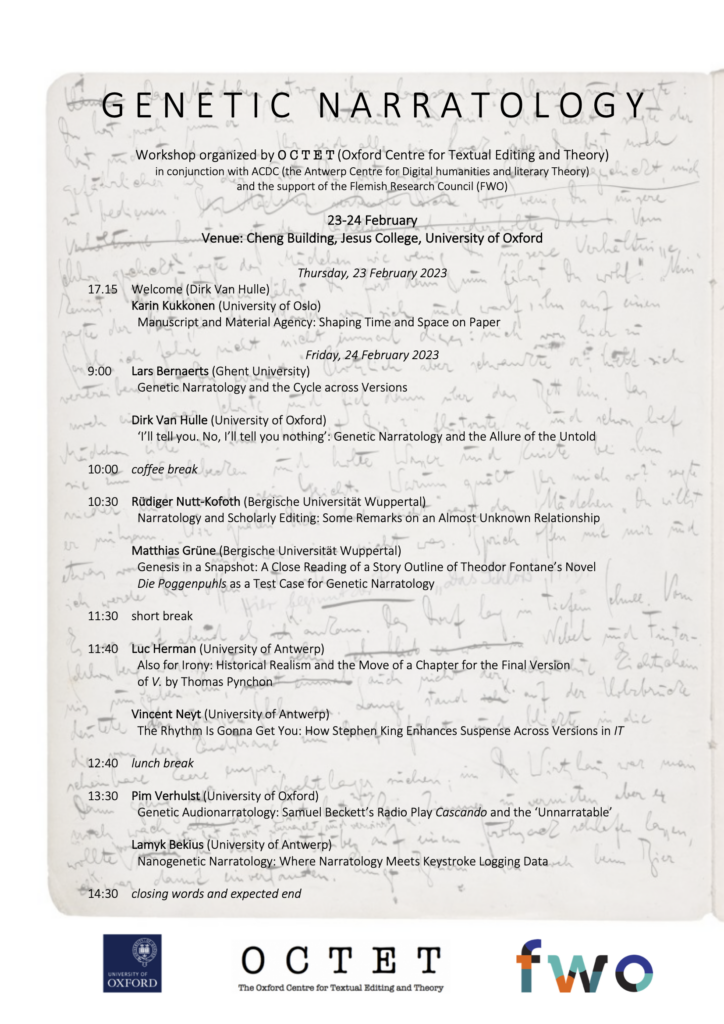
]]>Genetic Narratology Workshop in Oxford2023-02-23T00:00:00+00:002023-02-23T00:00:00+00:00https://vneyt.github.io/stephenkingatwork/2023/02/23/genetic-narratology-workshop-in-oxfordToday and tomorrow the University of Oxford and the University of Antwerp are organizing a workshop on the topic of our research project: genetic narratology. Here is the program:
]]>An Appreciation of Chuck Verrill2023-02-11T00:00:00+00:002023-02-11T00:00:00+00:00https://vneyt.github.io/stephenkingatwork/2023/02/11/an-appreciation-of-chuck-verrillI’ve been writing about Chuck Verrill’s work as the editor of IT these past weeks in my PhD, so I thought I’d take the time to express my appreciation here for Stephen King’s long-time editor, agent, and friend. Verrill passed away a little over a year ago, on the 9th of January 2022.
King first met Verrill as the assistant to Alan Williams, King’s first editor at Viking, who edited The Dead Zone (1979), Firestarter (1980), Cujo (1981), Different Seasons (1982), Christine (1983), and The Talisman (1984), before leaving Viking for Putnam. Williams’ exit meant a promotion for Verrill at Viking, and I believe IT might have been the first King novel that Verrill edited—the first of many.
King later recalled meeting Verrill:
[W]hen I moved to Viking I had an editor named Alan [Williams] and his assistant was a guy named Chuck Verrill and at that time Chuck was answering phones and doing memos. He’s like a boy, that’s how young he looked. Alan moved somewhere or retired, I can’t remember which, and Chuck started to edit the books. There was some discussion at the time because he was young, and I said: “Chuck’s OK.” So Chuck and I have been together since about 1988 or something. It’s going on 30 years now. So he’s not afraid of me, he knew me when, so to speak, and he’s a great concept editor and he’s a great line editor.1
So far, I haven’t been able to find any details on when King signed a contract for IT—there were no announcements in the trade press to my knowledge—but I believe it must have been in 1983. There is a photocopy at King’s archive of his first draft of IT that has many handwritten comments by Verrill in the margins. I believe King sent the copy not long after Viking had bought the hardcover rights, because he wanted his newly appointed editor’s opinion before he undertook his second draft.
It’s obvious from Verrill’s comments that he liked the novel very much. There are edits and queries on 307 of the 1147 pages of the draft. Verrill flagged repetitions, redundancies, and overused words, phrases, and events; he questioned potential weaknesses or errors in the narrative logic of some events or of the characters’ thoughts, emotions, and motivations; he pointed out opportunities to highlight themes; and he suggested cuts and trims here and there. He asked King some tough questions, why it is, for instance, that Stan Uris is the first person that Mike Hanlon calls. When King officially submitted IT to Viking for publication in early 1986, Verrill went through the text (in its third draft form) with great attention to detail. IT was a challenge, with its hundreds of characters and many dates.
Authors often have a love/hate relationship with their editors, love turning to hate when they receive their text back from their editor filled with questions, comments and suggestions for cuts and changes. King talked about his collaborations with Verrill along these lines in an interview in 1993:
I want an editor that’s fairly tough on me. I’m in the process of rewriting a book now and I’ve got a manuscript that’s covered with line edits. The editor’s name is Chuck Verrill. He’s very very good and at this stage in the manuscript, I could kill him. […] He won’t let me be Stephen King. That’s the most important thing. […] He will not let me be a Macy’s Thanksgiving Day Parade Float, you know, a big, inflated cartoon figure. […] He’ll change plot developments, and sometimes suggests that a lot of stuff should be switched around. The most valuable thing, from my standpoint is: he will cut what I’ve written. Because I have a tendency to write long. […] [Making the cuts] always hurts. It always hurts.
The complete interview is available on YouTube:
Verrill edited all of the novels King published with Viking from IT onwards, and, on a freelance basis, many of the novels published by Scribner. You can find references to Verrill all throughout King’s work. In Misery (1987), Paul Sheldon meets up with his editor, Charlie Merrill. King dedicated Secret Window, Secret Garden (1990) to Verrill. The Editor’s Note at the front of The Regulators (1995) is signed “Charles Verrill of New York City”. Verrill also makes an appearance of sorts in The Dark Tower (2004), when King’s fictional self thinks: “He has promised himself that he’ll try not to stuff his Dark Tower fantasies with unpronounceable words in some made-up (not to say fucked-up) language—his editor, Chuck Verrill in New York, will only cut most of them if he does—but his mind seems to be filling up with such words and phrases all the same”.
King thanks Verrill in the “afterthoughts” to Duma Key (2008): “I also want to thank Chuck Verrill, who edited the book with his usual combination of gentleness and ruthlessness”. In Finders Keepers (2015), King added: “He’s been my go-to guy for thirty years, smart, funny, and fearless. No yes-man he; when my shit’s not right, he never hesitates to tell me.”
Verrill hasn’t given many interviews about his work with King, in fact you can hardly find any information about him on the internet at all. He was interviewed for the 1999 documentary “Stephen King: Shining in the Dark”, which you can watch in full on YouTube.
King posted about Verrill’s death on twitter. I suspect one of King’s following novels will include an homage to Verrill, as he did with his friend and research assistant Russ Dorr in the afterword to The Institute (2019).